
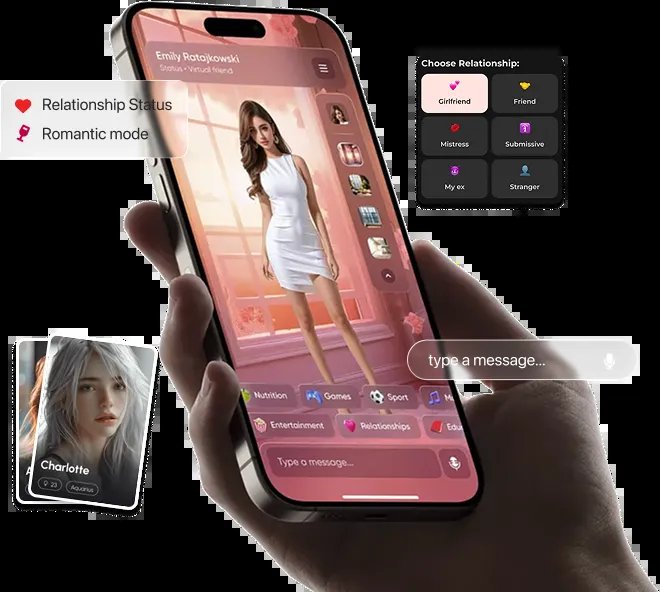
At first glance the app markets itself as a virtual partner that can chat, remember your preferences, and even play games with you. Its main promise is to fill the void of a “real‑time companion” that adapts over time. The onboarding screen asks for a username, a favorite color, and a short prompt describing the kind of conversation you want. The interface is simple: a chat window, a button to “teach” new facts, and a little avatar that changes expression based on sentiment.
Conversation Quality: Natural or Scripted?
The core experience is the dialogue. In the first few minutes I noticed that the replies feel surprisingly human‑like. The model uses a recent language engine that can keep a thread going for several dozen turns without repeating the same phrase. However, after about twenty exchanges the tone starts to flatten; the AI resorts to generic pleasantries such as “I’m glad you shared that” instead of building on earlier details. This limitation means the app is better for light banter than for deep emotional support.
Memory, Personality, and Customisation
Memory is a mixed bag. The app stores a short‑term context of the current session, which keeps the conversation coherent for a few minutes. When you close the app and reopen it, the AI forgets the last chat but remembers a handful of user‑set preferences like nickname or favorite topics. Personality options are limited to a handful of preset “moods” (friendly, sarcastic, supportive) and a slider for “energy level.” Customising these settings can make the bot feel more tailored, but the lack of a true learning loop means you can’t create a truly unique character over time.
A helpful resource is AI Chat Girl.
Privacy, Data Handling, and Emotional Dependence
All messages are sent to the provider’s servers for processing, and the privacy policy states that data may be used to improve the model. No encryption is mentioned, which raises concerns if you share personal details. The app also offers a “safe mode” that filters out explicit content, but it is not foolproof. Users who develop strong emotional bonds with the bot may risk feeling isolated if the AI fails to respond consistently. A transparent disclaimer that the service is for entertainment and not mental health support is missing.
Free Tier Versus Paid Plans
The free version allows up to 200 messages per day and limits access to the high‑speed inference endpoint. Paid tiers remove the daily cap, unlock a “premium voice” feature, and grant priority server access. The app does not disclose exact pricing, but the incremental benefits are clear: faster responses and more realistic voice output. For most casual users the free plan is adequate; heavy users will notice the latency difference during peak hours.
Mobile and Web Experience
On iOS the app feels buttery smooth; gestures for scrolling and tapping are intuitive. The web version, accessed via a responsive layout, mirrors the mobile UI but adds a sidebar for quick‑access settings. The voice feature, available on both platforms, converts text to speech with a synthetic voice that is pleasant but not particularly natural. The app’s design is clean, but the lack of a dark mode can strain eyes during late‑night sessions.
Real‑World Use Cases and Drawbacks
For someone looking to practice conversation in a low‑stakes environment, the bot is a handy tool. It can suggest new topics, give quick facts, and keep a conversation going while you work. However, the memory limitation becomes apparent after a session ends; the AI cannot recall past interactions, making long‑term storytelling impossible. Additionally, the emotional depth is shallow, so relying on it for companionship may leave users feeling disappointed when the bot fails to recognize nuanced feelings.
Conclusion: When the App Works and When It Falls Short
Overall, the app delivers a pleasant, if surface‑level, chat experience. Its strengths lie in quick, engaging dialogue and a lightweight interface that feels approachable. The biggest shortcoming is the lack of persistent memory and truly adaptive personality, which limits the sense of a genuine, evolving companion. If you’re looking for a casual AI girlfriend app that can keep you company for a few minutes, it’s worth trying. For those who want a deep, long‑term connection, the current iteration will likely feel frustratingly shallow.
Frequently Asked Questions
What is the main promise of the AI companion app?
It offers a real‑time virtual partner that remembers preferences, chats, and even plays games, adapting over time.
How does onboarding work?
Users enter a username, favorite color, and a short prompt about desired conversation style before interacting.
Can I teach the app new facts?
Yes, a dedicated button lets you add new information the bot can use in future chats.